


| Fundamental |
| Market reaction |
| Customer response |
- Original content, please do not reprint.
The chip price surge cycle has finally arrived. While memory prices and ON Semiconductor's hikes were the only notable increases earlier, most manufacturers are now quietly raising prices
across the board—even some capacitors are joining the trend. What's the current state of the chip spot market, and how are end-users responding?
Fundamental

The recent chip price surge isn't a temporary market anomaly, but a broad-based increase across the entire supply chain. The primary driver is rising costs of core raw materials. If pork
feed prices go up, how can pork chops stay affordable?
Here are the materials that are being increased in price:
Material category | Representative species | Increase / Price Change | Key driver |
| noble metal | silver | About 50% of the total within the year | Demand for passive components (MLCC/inductor) + tight supply of minerals |
| tin, copper, bismuth, cobalt | Copper prices surge across the board, showing a significant increase from September to December | Copper Foil Processing Fee Increased Due to Electronic Interconnection and Power Device Demand
| |
| electronic substrate | electronic copper foil | 82,000 yuan / ton in September → exceeded 92,000 yuan / ton in December | AI servers fuel CCL demand, resulting in tight production capacity |
| electron-grade glass fiber cloth | Supply can't meet demand, prices keep rising | Taiwan Glass and other companies face production capacity restrictions due to limited high-end CCL (Copper Clad Laminate) output. | |
| CCL( CCL ) | From November to December, major manufacturers raised prices by 8%–20%, with some daily increases of 2%–4%. | The combined costs of copper foil, fiberglass, and resin extend the delivery period to 20–45 days. | |
| wafer / fabrication material | Silicon wafer (advanced process) | Advanced process technology demonstrates significant price increases amid contract manufacturing cost hikes | TSMC's 5nm and below processes are expected to rise by 8%-10%, with 2nm showing significant premium. |
| passive element material | electrode slurry / magnetic core | Fenghua、High-Tech and other companies have seen their stock prices rise by 5% to 30%. | Silver surges as AI and automotive demand drive |
Every major technological breakthrough disrupts its supply chain, and the semiconductor supply chain is now experiencing its first such shock.
The surge in AI demand has put the high-end supply chain of components in a tight state, leading to a search for substitutes for high-end components. Unexpectedly, even these
substitutes have seen price hikes, allowing many China chip manufacturers to make substantial profits.

Market reaction
When supplies are plentiful, suppliers beg you to buy; when shortages occur, they threaten: 'If you don't buy today, I'll raise prices tomorrow.' Suppliers gain leverage, and the
market shifts toward a seller's market.
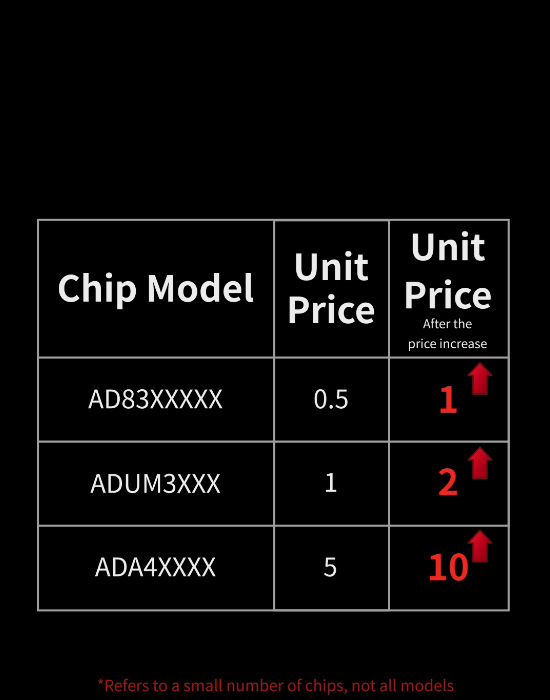
 A small number of chips saw their price difference between November and December double. Customers who didn't purchase in November ended up placing orders at higher prices.
Of course, this doesn't apply to all chips.
Customer response
Even if pork chops are pricier, customers still have to eat them.In November, clients who doubted the chip price hike kept saying 'wait and see,' but ended up buying chips at high prices
in December. Customers who initially imposed excessive requirements no longer needed to sign contracts or provide certificates, and their supplier terms became more lenient.
The semiconductor supply chain is transitioning from a three-year buyer's market to a seller's market. Will the semiconductor supply chain undergo a major transformation in 2026? Share
your insights in the comments below!