


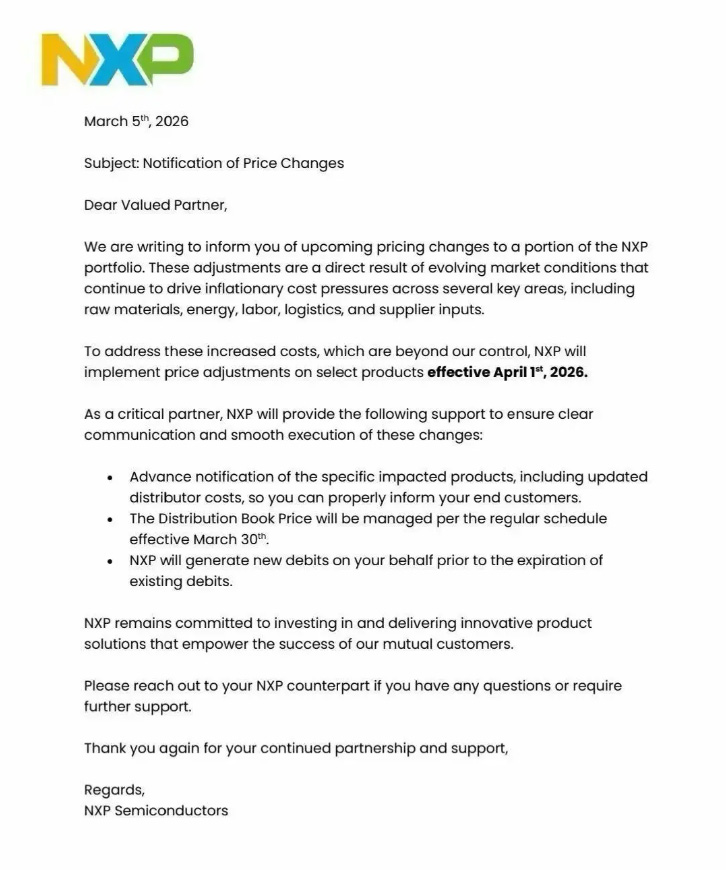
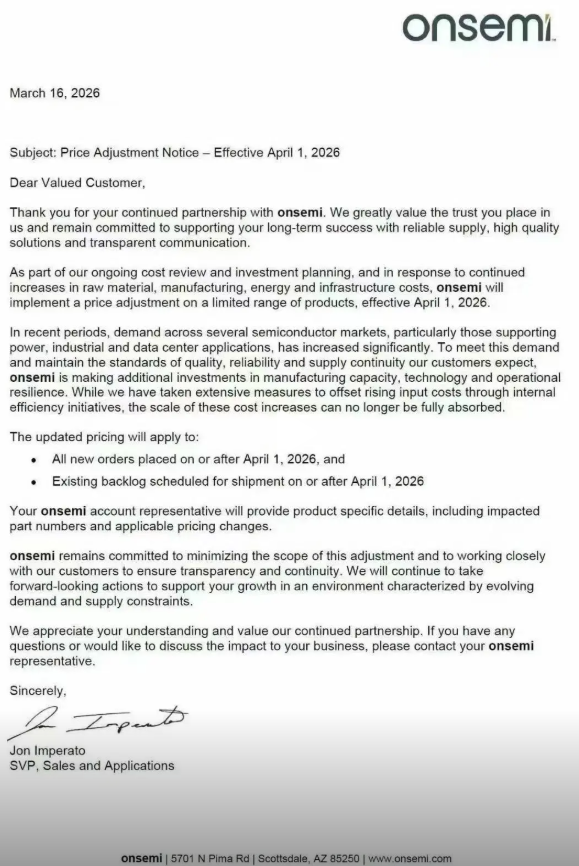
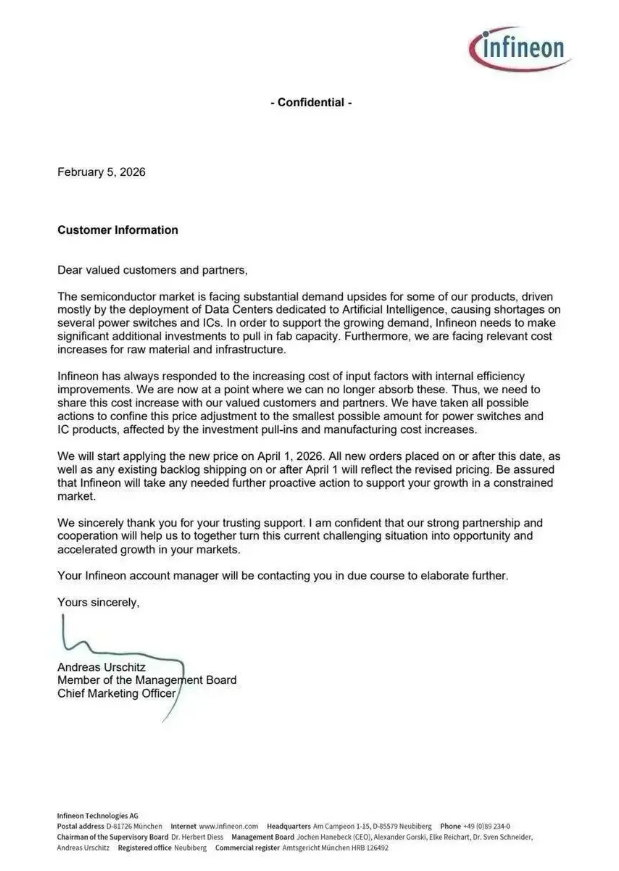
As April 1st, April Fool's Day, approaches, the semiconductor industry is once again experiencing a wave of price increases. International chip giants such as Infineon, Texas Instruments, NXP,
and ON Semiconductor have consecutively issued price adjustment letters, officially announcing that they will raise product prices starting April 1st. Domestic chip manufacturers are also
following suit to initiate price adjustments. Is this some kind of new joke in the chip industry? Many terminal manufacturers probably wish it were just an April Fool's Day gimmick.
Unfortunately, this is neither a sensational gimmick nor an April Fool's Day prank; it is a genuine structural price increase implemented in the semiconductor industry's supply chain.
The fact that it coincides with April Fool's Day is merely a coincidental timing.
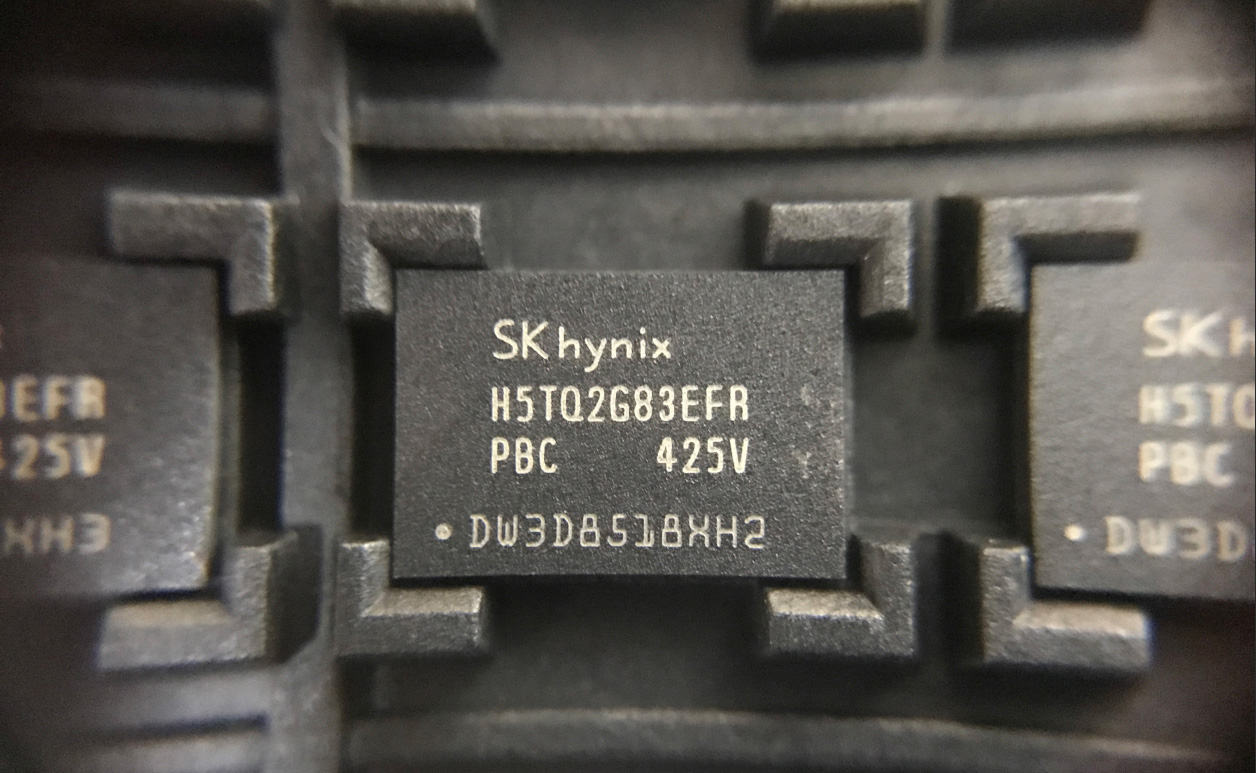
In reality, this is not the first time chip manufacturers have chosen April 1st as the effective date for price adjustments. On April 1, 2025, global memory chip leaders such as Samsung, Micron,
and SK Hynix simultaneously initiated price increases for NAND flash products, with hikes generally ranging from 10% to 15%, marking a significant turning point in the memory industry cycle.
The price increases in 2026 are even more extensive, affecting a wide range of products from power devices and analog chips to automotive-grade and industrial-grade chips, as well as core
chips for AI server support. The price increase ranges from 5% to 85%, and all adjustments are documented in official letters, carrying full commercial validity and certainly not a joke that
can be easily revoked.
Many people are curious: since it's not a joke, why is it that April Fool's Day was specifically chosen? The core reason is completely unrelated to the entertainment aspect of "April Fool's
Day" and is entirely driven by the commercial and financial rules of the semiconductor industry, forming an industry consensus.
Firstly, April 1st is the start of the second quarter of the natural year. The vast majority of international chip manufacturers use the natural year as their fiscal year, and the beginning of
a new quarter is the optimal time to switch to a new annual budget, capacity planning, and pricing strategy. A unified effective date facilitates the separation of old and new quotations
by the original manufacturers, achieving a synchronized global transition of the price system across channels, agents, and end customers, thereby minimizing financial settlement
confusion to the greatest extent.
Secondly, this is a tacit pricing window formed through industry collaboration. After leading manufacturers announce price adjustments, a follow-the-leader effect quickly takes shape
within the industry. A unified effective time can avoid the risk of customer churn caused by a single manufacturer raising prices alone and can also effectively reduce the impact of
channel arbitrage and customers stockpiling in advance on capacity delivery, forming an industry-wide tacit agreement on price adjustments. Meanwhile, most long-term agreements and
agency contracts in the chip industry are executed on a quarterly basis, and using April 1st as a dividing point can clearly delineate the scope of application for old and new prices,
minimizing commercial disputes and legal risks to the greatest extent.
In the end, the core confidence of chip manufacturers to collectively raise prices is never the April Fool's Day gimmick, but the fundamental changes in industry supply and demand, costs,
and cycles. The AI boom has led to a capacity suction effect, continuous rises in upstream raw material and production costs, and the release of demand due to downstream terminal
inventory replenishment, which are the core drivers of this wave of price increases. For the industry chain, it is more important to pay attention to the changes in the industry cycle and
the stability of the supply chain than to dwell on the coincidence of dates. After all, this wave of price increases sweeping across the entire industry was never just an April Fool's Day joke.
Here is a summary of the semiconductor companies that have announced price increases on April 1st, along with the related price increase notices they have released:
Source of information:Electronics Supply and Manufacturing-China(ESMC)、TrendForce、Snowball、NetEase News